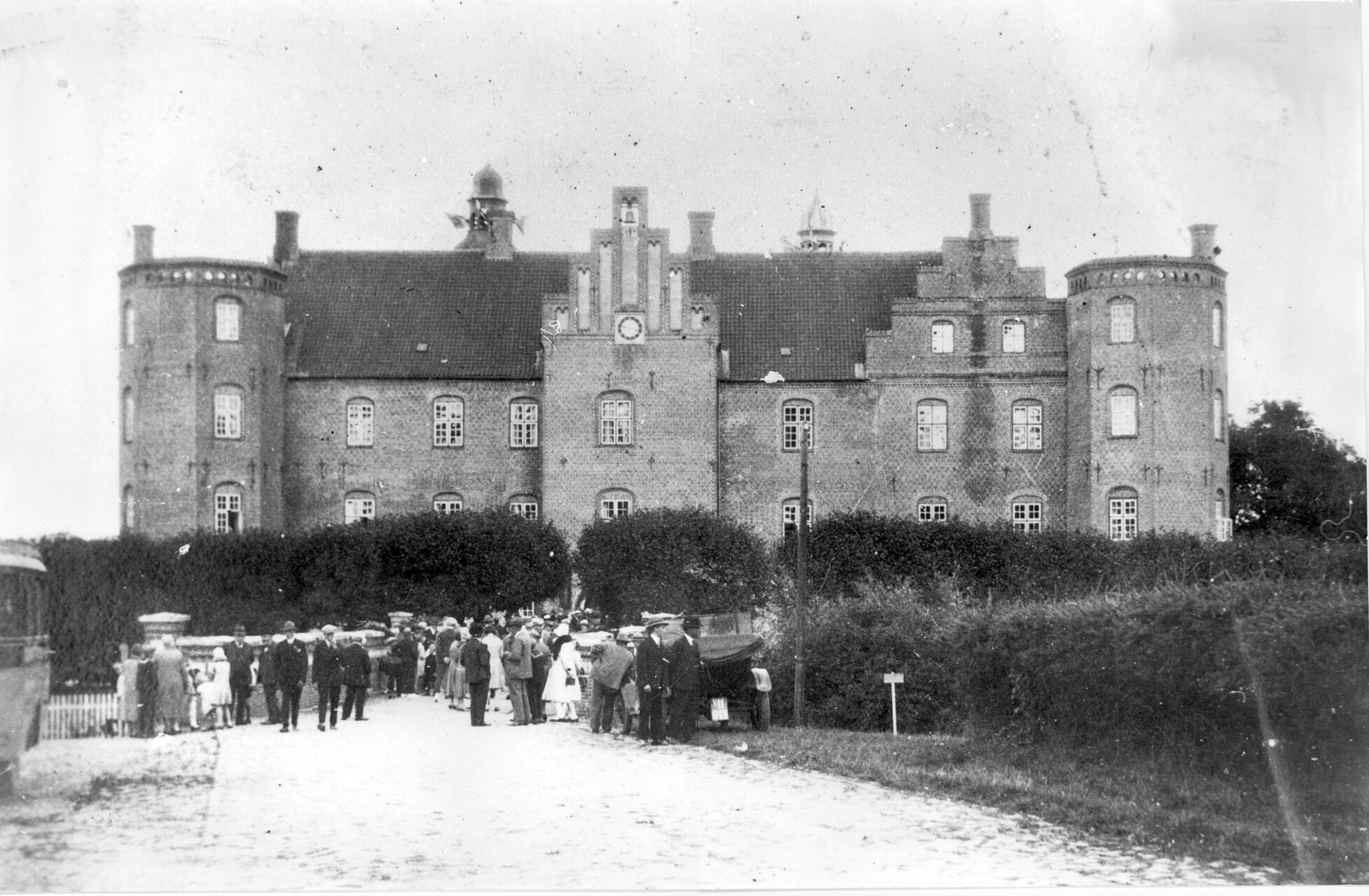
The Last Count and the Founding of the Museum
In 1920, the dissolution of entailed estates was carried out at a political level. This meant, among other things, that the entailed estate system was abolished and that all heirs would inherit on equal terms. For 600 years, Gammel Estrup had not been sold but had been passed down from father to son or daughter.
When Christen Scheel (1853–1926) died, there were eleven heirs. None of them had the means to take over the estate alone, so the family decided to sell it.
A son-in-law, Valdemar Uttental, purchased the main building in 1928, and in collaboration with public and private stakeholders, the self-governing institution Gammel Estrup – Jutland’s Manor House Museum – was established in 1930. The farm buildings and surrounding lands continued to operate as a farm until 1969, when the state acquired the farm buildings and the state-owned Danish Agricultural Museum (today The Green Museum) moved in.
In 2018, Gammel Estrup changed its name to Gammel Estrup – The Manor & Estate Museum